



What Fort Worth Homeowners Need to Know Before They Build
Quick Answer
Not always, and sometimes never. Homes with brick veneer, cantilevered floor framing, or thin engineered rim boards often cannot safely carry a bolted deck ledger, no matter how it’s fastened. In those cases the fix isn’t a stronger bolt, it’s a different structural approach: a freestanding or cantilevered deck that never ties into the house at all. JCustom’s go-to solution for most North Texas homes is a steel subframe system that sits on its own piers, mimics the look and threshold gap of a ledger-attached deck, and never loads the house structure.
Can every deck be tied into the house?
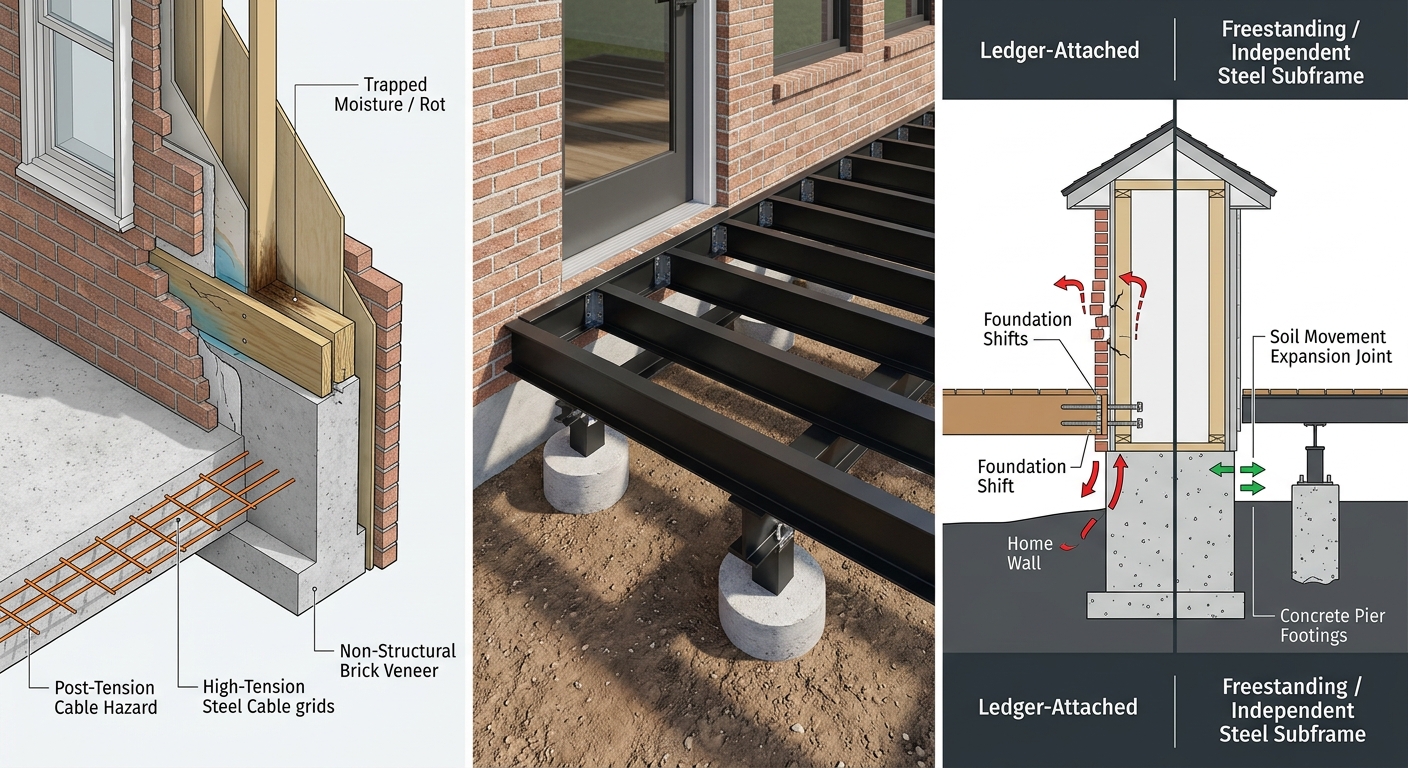
No. Brick veneer, cantilevered floor sections, and some engineered rim boards can’t take the load safely, regardless of hardware. Even a concrete foundation isn’t automatically safe to anchor into. Most North Texas homes built since the mid-1990s sit on post-tension slabs, concrete reinforced with steel cables pulled to tens of thousands of pounds of tension after the pour. Those cables run in a grid a few feet apart under the slab, and drilling an anchor bolt without knowing exactly where they are can sever one. A severed cable can snap back violently enough to damage the foundation or injure whoever’s nearby, on top of undermining the very structural integrity you were relying on. Anchoring to a concrete foundation has to be scoped around the cable layout, not just assumed safe because it’s concrete.
Why do some deck bids come in cheaper? Ledger-attached decks need less subframing because the house does part of the structural work. Freestanding and cantilevered systems require their own full support, which is more material and labor.
Is a deck not attached to the house less sturdy?
No, done right, it’s often stronger and more resilient than a ledger-attached deck. A properly designed subframe carries its own load and isn’t at the mercy of the house’s connection failing. And if you’re already dealing with the reality of Texas clay soil shifting your foundation, this matters even more: an independent deck system means the deck and the house move separately. If the ground shifts under one, it doesn’t drag, crack, or misalign the other. You’re not adding another point where your home’s foundation movement becomes your deck’s problem, or where your deck’s movement becomes your home’s.
Why “Just Bolt It to the House” Doesn’t Work on Every Home
A deck ledger sounds simple: bolt a board to the side of the house, hang joists off it, done. On paper. In the field, whether that’s even an option depends entirely on what’s behind your siding.
Brick veneer homes. The brick on the outside of most North Texas homes isn’t structural. It’s a decorative layer with an air gap behind it, tied back to the framing with thin metal ties. It was never designed to carry the weight of a deck, and bolting through it either crushes that air gap or turns the bolts into a lever pulling the brick off the wall. Some jurisdictions won’t permit ledger attachment to brick veneer at all.
Cantilevered floor sections. Common on two-story homes where the upper floor overhangs the lower wall, garrison-style construction. The band joist out at the edge isn’t sitting on the foundation, it’s just nailed into the end grain of the floor joists behind it. That connection was never built to carry deck load on top of what it’s already holding.
Thin or engineered rim boards. Some newer homes use engineered rim board or foam insulation sheathing at the floor line instead of solid dimensional lumber. These often can’t take a standard ledger connection without extra engineering, and in some cases can’t take one at all.
In Godley, Benbrook, and newer developments around Fort Worth we often see post-tension “cable” slab foundations. This is probably the greatest risk for tying into a home’s foundation with a ledger board. Hitting one of these creates serious damage to the home’s foundation.
The Big Risk: What Happens Behind the Ledger
Code compliance isn’t just a permitting checkbox, it’s there because ledger failures have a real, ugly failure mode: water.
Every ledger connection needs flashing that routes water away from the house. When that’s skipped or done wrong, water gets trapped between the ledger and the house sheathing. Over months and years, that moisture rots the band joist, the wall sheathing, and sometimes the floor framing behind it, damage that’s often invisible until the deck starts to sag, pull away from the house, or an inspector finds it.
This is the scenario JCustom deals with more than almost anything else.
See our post on deck framing failures for more on how these connections fail over time.
Josh and the crew are regularly called out for one of two situations:
Removing an old ledger-attached deck and finding the studs and rim joist behind it rotted out from years of unsealed, unflashed attachment, requiring reframing before anything new goes in.
Replacing a deck that failed because it was tied into the house incorrectly in the first place, sagging, separating, or simply not holding up the way it should have.
What the Code Actually Requires
For homes where ledger attachment is structurally possible, the International Residential Code is specific about how it has to be done: through-bolts or lag screws only, never nails or deck screws, sized and spaced according to the joist span, plus a separate lateral load connection using hold-down hardware.
Why Some Bids Come In Cheaper Than Others
If you’ve gotten a few quotes and noticed a real spread in price, this is often why. A deck that ties into the house with a ledger needs less subframing, the house is doing part of the structural work. A freestanding or cantilevered deck needs its own complete support system: full framing, its own piers, no shortcuts. Often this is not clearly called out in estimates you might see a simple description such as “2×8 Treated Framing” which doesn’t specify the attachment method, creating a question around cost variation.
What JCustom Recommends Instead
When a house can’t take a ledger, or when a homeowner wants a sturdier, longer-lasting system regardless, JCustom’s default recommendation is a steel subframe (Link Opportunity, we don’t have a piece written on steel subframe).
Here’s what that solves:
It never touches the house structurally. The deck cantilevers off its own piers, keeping the same tight gap at the door threshold you’d get from a ledger, without any of the load transfer.
It moves independently of the house. Texas clay soil expands and contracts through the year, and houses and decks both shift with it. A steel subframe with no hard connection to the house acts like a built-in expansion joint. If the ground moves, the deck and the house aren’t fighting each other.
It works with very little clearance. As little as four to six inches between the threshold and the ground is often enough, which matters on homes where a full wood substructure wouldn’t fit.
It doesn’t rot, warp, or feed termites, and it holds a dead-flat plane for the life of the deck.
For homeowners where the steel option is outside budget, JCustom’s second recommendation is a wood-framed sled system: still pier-supported and independent of the house, with the deck frame sitting on top of a standard frame rather than tying in. It needs more clearance under the threshold than the steel option, but it’s a solid, budget-conscious way to get the same freestanding structural benefit.
When in doubt!?
If the answer isn’t clear for mounting a decking system to a ledger board or independent sub-frame system JCustom will always have a certified engineered review the structure details and sign off (Stamp) our drawings to confirm that the ledger system meets code requirements, safety requirements, and structural integrity for a deck system that will last 20+ years.
What to Ask Before You Sign a Contract
Mirroring the format from the framing post, for consistency:
Ask whether your home’s exterior can structurally support a ledger, and how they know.
Ask what subframe system they’re proposing if it can’t, steel or wood, and why.
Ask how much clearance you have at the threshold and whether that limits your options.
Ask whether they’ve flashed and sealed correctly on any ledger-attached section, and how they’ll prevent water intrusion.
Ask why the bids in front of you differ, and whether it’s a subframing difference like this one.